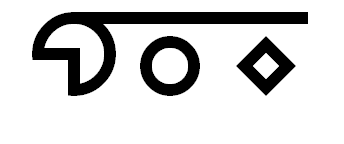
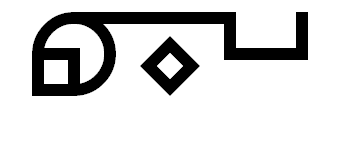
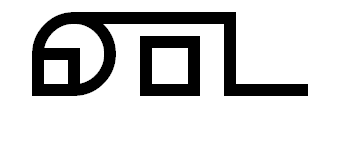
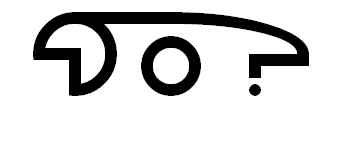
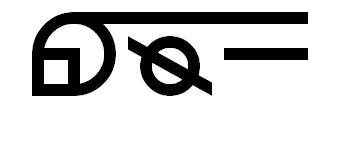
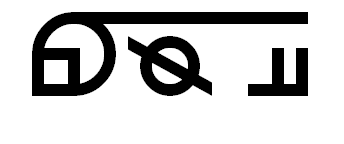
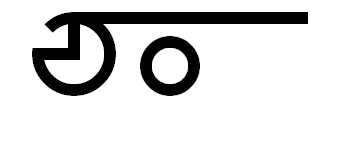
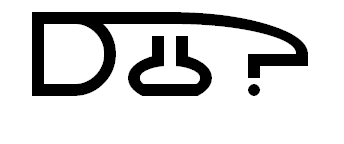
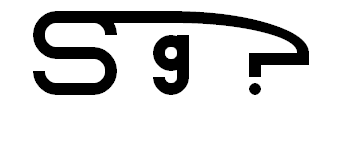
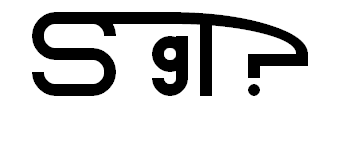
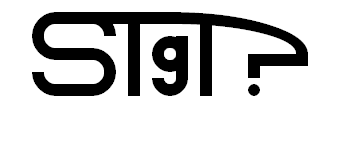
Please consider the sign in the following image that Google Street View gathered at the Museum of Modern Art in New York.
There is a full screen button to the left of the x in the top right corner of the image. The + sign at the left allows zooming-in.
Viewing thiat image inspired me to produce the folloiwng idea.
Suppose, for example, that an art gallery has two signs, one displaying the phrase “Welcome” and one displaying the phrase “Thank you for visiting”.
For the example, please suppose that the signs are in English.
Suppose that the Welcome sign has a passive RFID (radio frequency identification device) tag that supplies the Unicode Private Use Area character U+E901 and that the Thank you for visiting sign has a passive RFID tag that supplies the Unicode Private Use Area character U+E902.
Suppose that a visitor to the art gallery has a mobile telephone of a type that can read an RFID tag. There are issues as to which type of RFID tag not addressed in this document, this document is an just an outline of the idea.
I am thinking that an application running in the mobile telephone could use the character picked up from an RFID tag to access a small database and display on the screen of the mobile telephone the message of the sign localized into the language spoken by the owner of the mobile telephone. The application would be available from the internet and the person obtaining the application would simply select the version that had a localization database in the language of his or her choice.
There would be a list of messages, symbols and Unicode Private Use Area character assignments quasi-standardized for the application.
The symbols could be used if a localization database for a particular language were not available.
This idea is related to the original non-RFID idea for a collection of localizable sentences encoded as Unicode characters for the purposes of communication through the language barrier.
That original idea does not need an RFID device, yet does need more than one communications device to be involved in a message transaction.
Thus there are standardization issues over using that idea. However, for the RFID idea where the communication involves only one person and one mobile telephone, the character code definitions are only local.
For the RFID idea, the signs in the art gallery need not be in English.
I am wondering if the idea could usefully be applied in other buildings as well as art galleries.
An art gallery seems a good place to start as two prototype signs could start as an exhibit of art.
I am thinking that I can produce a list of code points, phrases and specially-designed symbols and publish the list together with a font for the symbols, mapped to the code points as in the list. For example, for signs such as Stairs, Café, Restaurant, Bookshop, Information Desk, Sculpture Gallery and so on.
It becomes more complicated with some signs, for example, Stairs, as maybe a direction arrow needs to be on the sign, perhaps pointing to the left or perhaps pointing to the right: then one needs to decide whether to include in the rfid tag text the character code point for an arrow pointing in the appropriate direction as well as the code point for the localizable sentence. The localization facility in the mobile telephone would need to use the code point for the localizable sentence to find the localized text from a database, yet pass the arrow code straight through to the display in the mobile telephone. That could then raise issues in relation to which arrow characters are supported in the font being used in the mobile telephone.
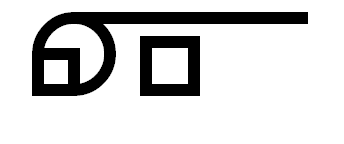
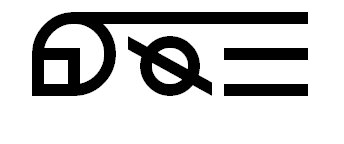
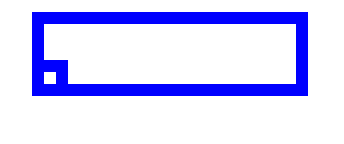
I have now designed a symbol to indicate to people visiting an art gallery that tags are available on signs.
I have added that into a new version of the font using the following sentence for U+E900.
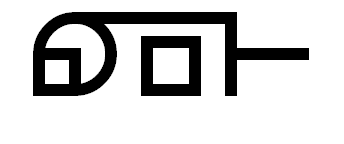
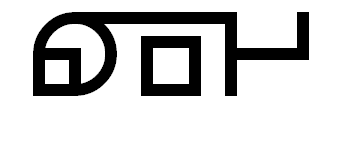
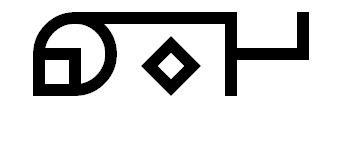
Some of the signage items each have a radio frequency identification device in the lower left corner.
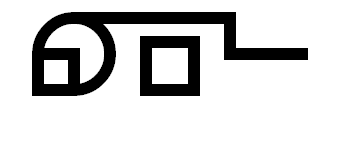
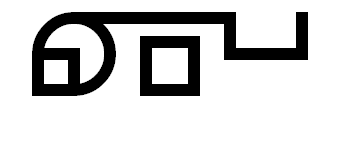
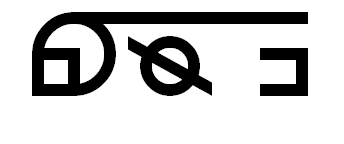
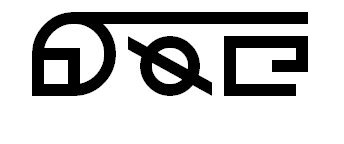
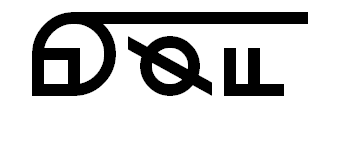
Please find attached two graphics that each show the logo that I have designed. I produced each graphic by displaying the glyph from the new font at 72 point in the Serif PagePlus X3 desktop publishing software package that I am using and then exporting the graphic as a png graphic.
Having the glyph in a font means that I can easily use it at various sizes as the design in the font is a vector image. Having the glyph in a font also makes it straightforward to change the colour when used in a desktop publishing package.
Like Welcome and Thank you for visiting, there is a character code point, a symbol and a sentence for U+E900.
However, whereas with U+E901 Welcome and U+E902 Thank you for visiting, the symbols would not usually be used, with U+E900 the symbol would usually be used on a signage item near the entrance of an art gallery, so as to inform people that the facility is available in the particular art gallery. That sign could be large or small, as desired, maybe almost as an exhibit or maybe just on the door like a sign indicating that a particular type of credit card is accepted.
However, the symbols for the sentences, Welcome, Thank you for visiting, Stairs and so on could be used on signs if so desired. If a symbol were used on a sign where the main text of the sign is in a natural language or maybe in several natural languages, one possibility would for the symbol to be to located at the lower left corner of the sign in approximately the same location as the rfid tag.
It would also be possible to use the symbols without an rfid tag.
In the absence of an rfid tag on a sign, or if the visitor to the art gallery does not have a mobile telephone set up for automated localization, the symbols could be understood using a printed guide.
Here are the code points that I have allocated thus far, so as to facilitate thought experiments.
U+E900 Some of the signage items each have a radio frequency identification device in the lower left corner.
U+E901 Welcome
U+E902 Thank you for visiting
U+E903 Stairs
U+E904 Café
U+E905 Restaurant
U+E906 Bookshop
U+E907 Information Desk
U+ E908 Sculpture Gallery
Thus far I have only produced a design for one of the glyphs, namely for U+E900.
As the idea is that this glyph would be displayed on a sign so that people would become aware that the facility is available in the particular art gallery, the glyph is also shown in blue, as that might be a better display colour than black.
Here is the LOCSE024.TTF font that contains the graphic for U+E900.
LOCSE024.TTF (75.5 KB)
The font also includes two other new sentence glyphs.
U+E1A1 Where can I buy a vegetarian meal with no gluten-containing ingredients in it please?
U+E1A2 Where can I buy a vegan meal with no gluten-containing ingredients in it please?
William Overington
1 December 2011